When an ME engineer encounters a design specification marked "Casambi BLE Mesh" for the first time, the first question is rarely "what is Casambi" but rather "what is BLE Mesh, and can it be trusted?" That is exactly the right question. Casambi is a lighting control platform, but the transmission layer underneath it is BLE Mesh, and that is what determines the reliability of the entire system.
BLE Mesh is not a new or proprietary technology invented by Casambi. It is an open standard published by the Bluetooth SIG in 2017, the same organization behind the classic Bluetooth that every engineer already knows. It runs in over 100 million devices worldwide, from stadium lighting systems to factory sensor networks.
This article explains how BLE Mesh works technically, how it differs from standard BLE and Zigbee, and why it is the right choice for commercial lighting infrastructure.
What is BLE Mesh?
BLE Mesh (Bluetooth Low Energy Mesh) is a wireless mesh networking protocol standardized by the Bluetooth SIG in 2017, enabling hundreds of devices to communicate in a multi-point topology within a single network without a central hub. Every device in the network simultaneously receives commands and acts as a relay node, forwarding signals to neighboring devices.
The fundamental nature of BLE Mesh is that it is an open standard, not a proprietary solution. The Bluetooth SIG is a technical consortium of over 35,000 member companies including Intel, Qualcomm, Nokia, and Samsung. The Mesh standard is developed and maintained by engineering teams across these organizations, not by any single vendor.
Casambi Technologies (Finland) builds its proprietary lighting firmware on top of this standard. That means when you deploy Casambi, the transmission layer underneath is technology validated by the global engineering community, not a self-developed protocol that lives or dies with one company.
How is BLE Mesh different from standard BLE?
Standard BLE uses a star architecture: one central device connects directly to each peripheral, coverage is bounded by the range from that central point, and if the central device fails the entire network loses control.
BLE Mesh replaces this with a fully decentralized model. There is no central device and no single point of failure. Each node in the network is independent and self-organizes into a mesh:
Star (standard BLE): The hub is the central point. All communication passes through it. If the hub fails, the entire network loses control.
Mesh (BLE Mesh): Each node is an independent junction. Signals find their own path through multiple intermediate nodes. If one node fails, the network re-routes automatically through the nearest active node.
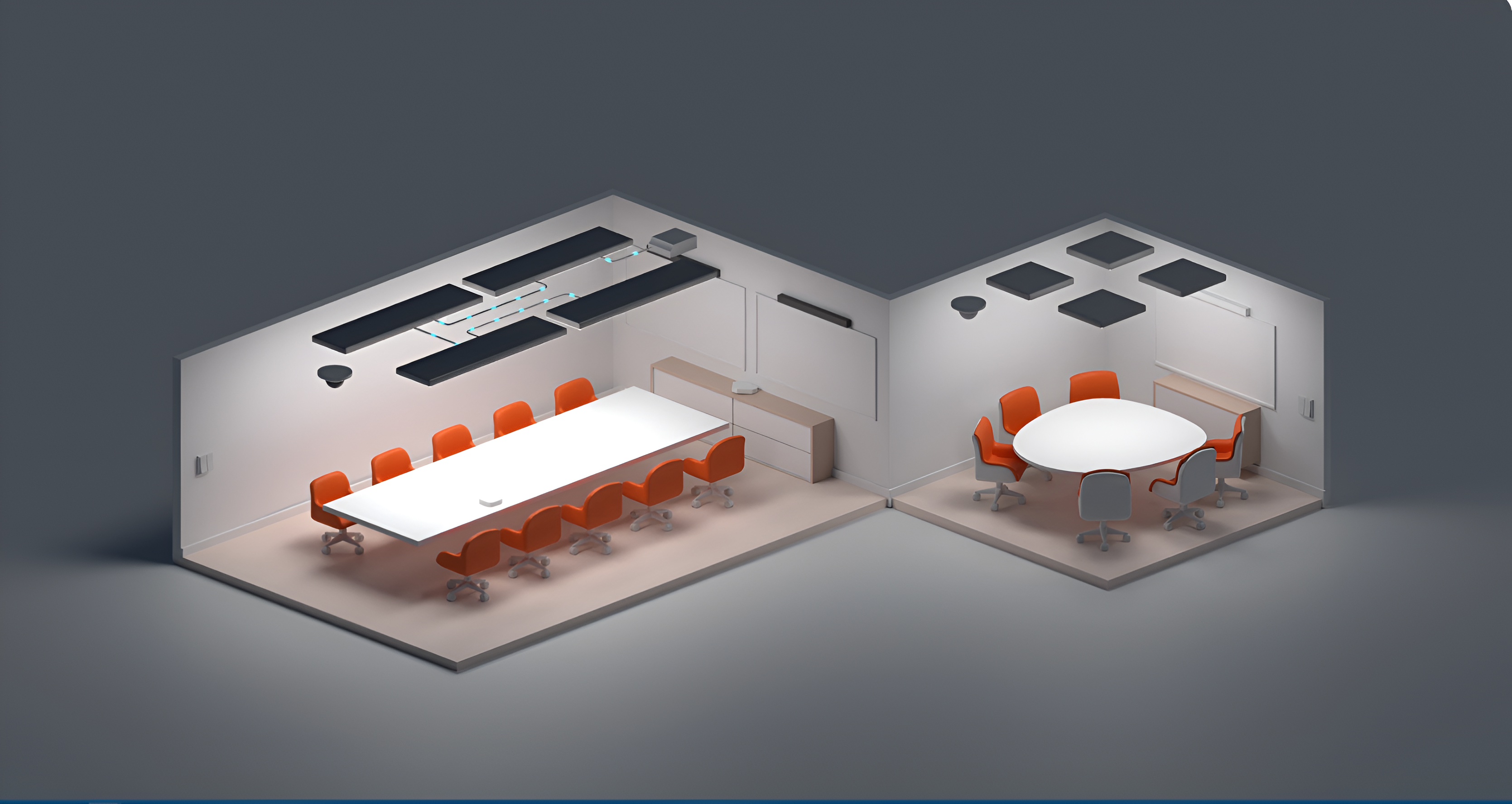
The practical implication: a 1,500 sqm office with 80 Casambi downlights, each luminaire is a node. When one lamp fails, the rest of the network is unaffected. Signals re-route through the nearest active node without any manual intervention.
How does BLE Mesh work?
BLE Mesh uses a publish/subscribe model to transmit control commands. Unlike point-to-point protocols, BLE Mesh uses group addresses to send commands to multiple devices simultaneously:
The sending device (switch, sensor, or app) publishes a message to a group address.
All devices that have subscribed to that address receive the message and execute the command.
The signal propagates via managed flooding: each node relays the message to neighboring nodes within BLE range.
TTL (Time-to-Live) limits the maximum number of relay hops, preventing infinite loops across the network.
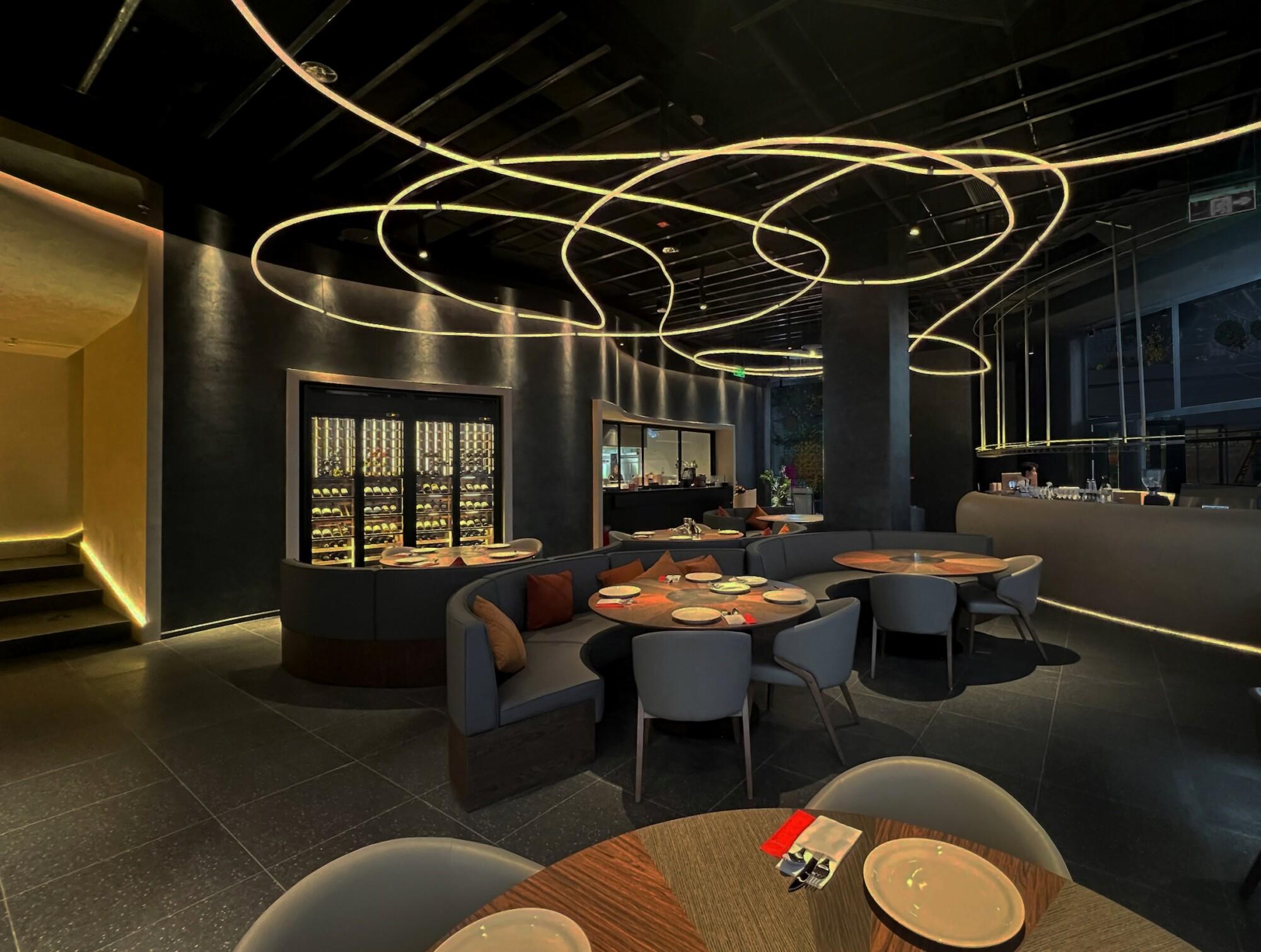
A practical example: a technician taps "Scene Restaurant Evening" in the Casambi app. The app publishes a message to the Group Address assigned to the restaurant zone. That message relays through intermediate nodes within a few hundred milliseconds until every subscribed node receives it and dims to 30% simultaneously. Total latency across a 60-node network is typically under 100ms.
The smartphone running the Casambi app is not a hub. It is simply a device that publishes commands into the network. When the phone is switched off or moves out of range, every node continues to run according to pre-configured schedules and sensor triggers. The network does not depend on the smartphone to keep running.
Why did Casambi choose BLE Mesh over Zigbee or Thread?
This question deserves a direct answer, because Zigbee and Thread are also well-established wireless mesh protocols. Three main reasons Casambi chose BLE Mesh:
No specialist commissioning hardware required. Bluetooth chips are already present in every iOS and Android smartphone. Technicians use the Casambi app to scan, group, and assign scenes directly, with no USB dongle or separate software. Zigbee requires a dedicated Zigbee coordinator. Thread requires a Border Router device on the network.
A durable open standard. BLE Mesh is one of the Bluetooth SIG standards, the same organization that maintains Bluetooth Classic and BLE. The standard has a clear development roadmap and does not depend on any single company the way Zigbee depends on Silicon Labs or Thread depends on Google and Apple.
Latency suited to lighting control. BLE Mesh at 2.4GHz delivers command latency under 100ms, which is sufficient for lighting to feel instantaneous to occupants. Thread has stronger IPv6 routing capabilities but adds infrastructure complexity and currently lacks the commercial DALI driver ecosystem that Casambi has built over more than a decade.
No protocol is perfect for every application. Zigbee has a broader ecosystem across general commercial IoT. Thread has native IPv6, which is genuinely useful for systems that need IP addressing at the node level. But for the specific problem of commercial lighting that needs fast commissioning and no additional infrastructure hardware, BLE Mesh is the most practical choice available today.
Real-world technical specifications
The figures below are based on both the Bluetooth SIG standard and real deployment experience in Vietnam:
Range between two adjacent nodes: 10 to 15 meters in buildings with concrete walls and plasterboard ceilings. Outdoors, this can reach 20 to 30 meters in open conditions.
Maximum nodes per network: The SIG standard theoretically supports thousands of nodes. Casambi limits a single network to 250 nodes to guarantee real-world performance and latency.
Command latency: Under 100ms in a 60-node network, sufficient for occupants to perceive switching as instantaneous.
Frequency band: 2.4GHz, 40 channels, using frequency hopping to minimize interference with Wi-Fi and other 2.4GHz devices.
Security: AES-128 encryption across all network traffic. Device authentication required when joining the network.
Power consumption: Very low. The BLE chip on a CBU-ASD module draws under 10mW during normal operation.
In practice, a 1,000 sqm office with 60 to 80 Casambi downlights rarely encounters coverage issues. A 200-room hotel project needs each floor or functional zone designed as a separate network boundary to calculate node counts correctly.
Limitations to understand before specifying BLE Mesh
BLE Mesh is not the right solution for every project. Three real-world limitations that engineers need to understand clearly before designing:
The 250-node limit is a Casambi constraint, not a BLE Mesh constraint. A building with 400 luminaires needs two networks. The two networks communicate via Casambi Cloud or via a Casambi Gateway. This needs to be planned at the design stage, not discovered during commissioning.
BLE Mesh has no native IP. A Casambi BLE Mesh network is a closed network that does not connect directly to the building's Ethernet infrastructure or VLAN. Exchanging data with a BMS or other IP-based system requires a Casambi Gateway as the bridge, supporting BACnet/IP and Modbus TCP.
Adequate node density is required. Spaces with thick concrete walls, strong RF-absorbing materials such as metal cladding or water-filled glazing, or EMI-shielded thermal insulation can reduce practical range to 5 to 8 meters between nodes. In these cases, node count needs to increase or additional sensors can be positioned to act as relay points.
These limitations are not reasons to disqualify BLE Mesh. They are the information needed to design it correctly. A properly specified BLE Mesh deployment is more reliable in practice than many DALI-2 systems that were installed quickly without verifying coverage.
Conclusion
BLE Mesh is a fully ratified wireless mesh protocol, standardized by the Bluetooth SIG and deployed at scale worldwide. It is not experimental technology or a prototype solution. Casambi builds on this foundation and has optimized it entirely for commercial lighting, from smartphone-based commissioning through to BMS integration via the Casambi Gateway.
If you are evaluating BLE Mesh for a lighting project, the article What is Casambi covers how Casambi applies BLE Mesh in real building deployments. For project-specific technical advice, contact us via hotline 0918.918.755 or email sales@knxstore.vn. KNXStore.vn is an authorized Casambi distribution and technical support partner in Vietnam.